Types of Business Insurance: Your Complete UK Guide
Let's be honest—navigating business insurance can feel like trying to learn a foreign language. Terms like public liability, professional indemnity, and business contents get thrown around, and it's easy to wonder: "Do I really need all of this?"
In essence, there are four main types you need to know: Business Contents (covers your physical stuff), Public Liability (covers injury or damage to others), Professional Indemnity (covers mistakes in your advice or services), and Employers' Liability (a legal requirement if you have staff). Most businesses need 2-3 of these, not all four.
The goal of this guide is simple: to walk you through each type in plain English and help you build the right custom protection for your specific business model. By the end, you'll know exactly what to look for.
The Foundation: Business Insurance (Covers Your Physical Assets)
Often called a business combined policy, this protects the physical things that make your business work. According to the Association of British Insurers (ABI), this cover is essential for any business that owns assets.
Here's what typically gets covered in a solid business insurance policy:
- Stock & Inventory: Whether you're a retailer with shelves full of products or a manufacturer with raw materials, this covers loss or damage from fire, theft, flood, or other insured events.
- Fixtures & Fittings: Those built-in shelves, display cabinets, lighting systems, and even custom countertops—they're often expensive to replace.
- Business Equipment: Laptops, computers, machinery, tools, and specialized equipment. A single piece of machinery can cost thousands to replace.
- Business Interruption: This is the game-changer. If a fire forces you to close for repairs, this covers lost profits and ongoing expenses like rent and salaries.
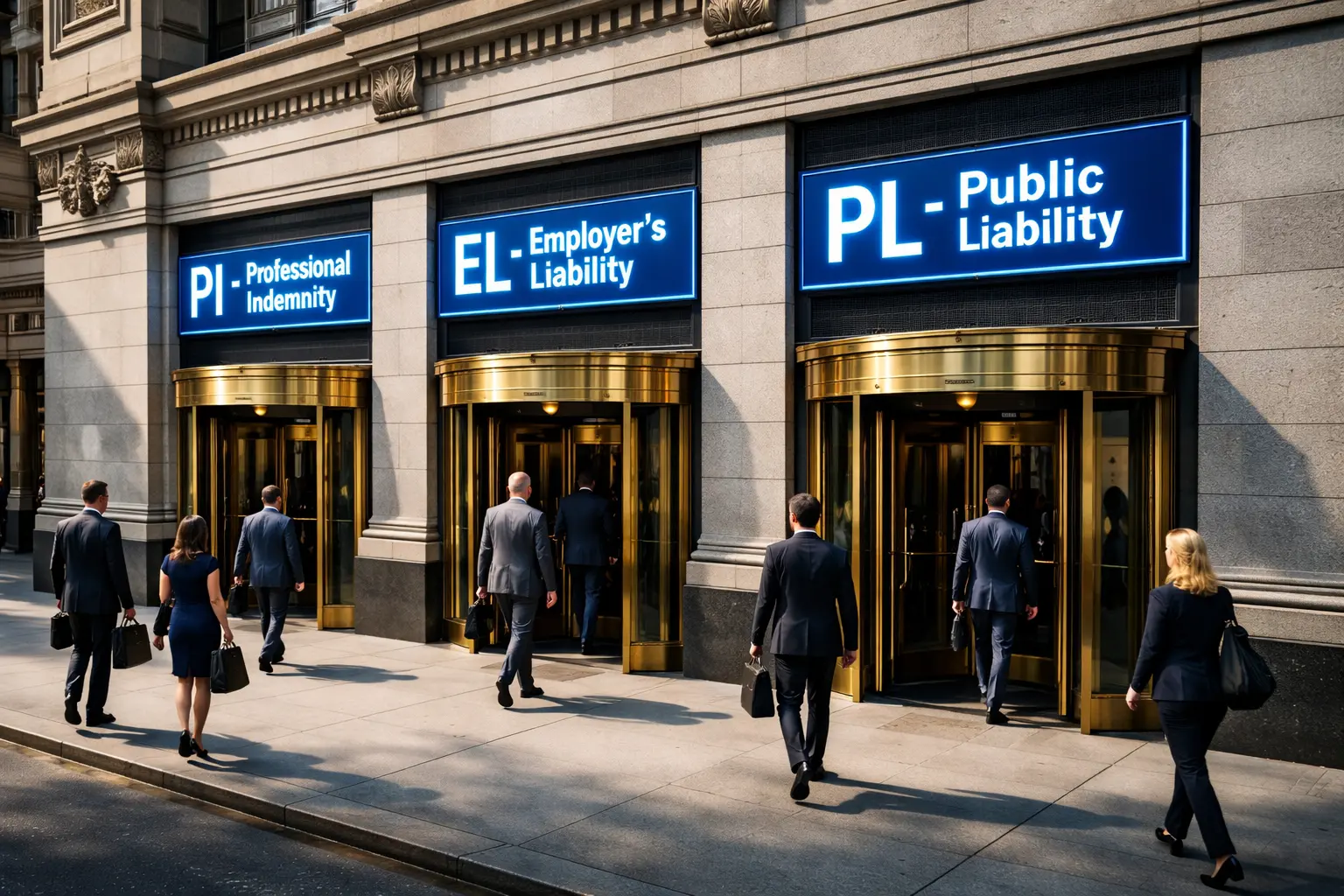
Liability Insurance: PL vs PI vs EL - What's the Difference?
This is where many business owners get confused. All three protect against claims people might make against you, but they cover completely different scenarios.
| Insurance Type: | What It Covers: | Who Needs It Most: | Legal Requirement? |
|---|---|---|---|
| Public Liability (PL) | Injury or property damage to third parties (clients, suppliers, visitors) caused by your business activities. E.g., a customer slips in your shop, a decorator damages a client's antique vase. | Any business with premises open to the public OR that works at client sites. Retailers, cafes, tradespeople, gyms, event organizers. | No (but often required by contracts) |
| Professional Indemnity (PI) | Financial loss suffered by a client due to your professional advice, design, or service. E.g., an architect's design error causes construction delays, a consultant's bad advice loses a client money. | Businesses that give advice, designs, or professional services. Consultants, architects, IT professionals, designers, accountants, marketing agencies. | No (but required by many professional bodies and client contracts) |
| Employers' Liability (EL) | Injury or illness to employees arising from their work. This includes compensation claims, legal costs, and even diseases that develop over time. | ANY business with employees (including part-time, casual, volunteers, apprentices, and even family members). | YES - required by the Employers' Liability (Compulsory Insurance) Act 1969. Fines up to £2,500 per day for non-compliance. |
Key Insight: Many businesses need both PL and PI but don't realize it. A web designer (needs PI for coding errors) who meets clients at their office (needs PL in case a client trips over their laptop bag) is a perfect example.
Which Insurance Fits Your Business Model?
Based on decades of experience, here are the most effective insurance combinations for common business types:
1. The Takeaway/Cafe Owner (Physical Premises + Public Access)
Essential Package: Business Contents + Public Liability + Employers' Liability (if you have staff).
Why this works: Your stock and equipment are your livelihood. Customers visiting your premises create slip/trip risks. Employees need legal protection. Add business interruption if you couldn't afford to be closed for weeks.
If this fits you, when getting a quote with us, select business insurance, then click liability required.
2. The Consultant/Freelancer (Service-Based, No Premises)
Essential Package: Professional Indemnity + Public Liability + Cyber Insurance (often overlooked!).
Why this works: Your advice is your product. If you visit clients or they visit you, there's still liability risk. Cyber insurance is increasingly vital—client data breaches or ransomware attacks can devastate service businesses.
If this fits you, when getting a quote with us, select liability insurance
3. The Tradesperson (Working at Client Sites)
Essential Package: Tools Insurance + Public Liability + Employers' Liability (if you have helpers) + Contract Works.
Why this works: Your tools are expensive and mobile. Working in clients' homes creates significant property damage risks. Contract works covers materials and half-finished jobs if something happens mid-project.
If this fits you, when getting a quote with us, select business insurance, then click liability required.
4. The Home-Based Business
Essential Package: Business Equipment (separate from home insurance) + Professional Indemnity or Public Liability (depending on your work) + Cyber Insurance.
Critical Note: Standard home insurance does not cover business equipment used for work purposes. You must declare business use to your home insurer or get separate business cover.
If this fits you, when getting a quote with us, select business insurance, then click liability required.
Common Pitfalls That Invalidate Business Insurance:
Avoiding these critical mistakes is as important as buying the right policy in the first place.
- Underinsurance: Insuring assets for less than their true replacement value triggers the "average clause," meaning insurers can reduce your payout proportionally. For example, insuring £50,000 of stock for £30,000 could leave you covering 40% of a claim yourself.
- Incorrect Business Description: Using vague or incorrect terms (e.g., "consultant" when you do hands-on installation) is material non-disclosure and can lead to claim rejection.
- Overlooking Policy Limits & Contracts: If a client contract requires £5m Public Liability but your policy provides £2m, you are in breach of contract and personally liable for the shortfall.
- Assuming Home Insurance Covers Business Use: Most domestic policies exclude business use. A major claim for business equipment or activities could be rejected outright.
The Golden Rule: When in doubt, disclose. A conversation with your broker is free; finding out you have no cover after a disaster is catastrophic.
The Bottom Line for UK Businesses in 2026
Business insurance has evolved from a simple "tick-box" requirement to a strategic business tool. The right combination does more than just protect against disasters—it gives you confidence to take on bigger clients, secure better contracts, and focus on growth rather than worry.
The landscape has changed significantly. Cyber threats are now mainstream. Supply chain issues make business interruption cover more valuable than ever. And with legal costs rising, proper liability protection isn't optional for any serious business.
The question isn't "Can I afford insurance?" but "Can I afford NOT to have the right insurance?" In a world where a single unexpected event can undo years of hard work, having the proper protection isn't an expense—it's one of the smartest investments you can make in your business's future.
Ready to build the right insurance protection for your specific business? Get a tailored, no-obligation quote today. We'll help you understand exactly what you need—no jargon, no pressure, just clear advice from FCA-regulated experts.